
Developing New Rice Varieties with Superior Yield and Functionality NTT and Tokyo Metropolitan University
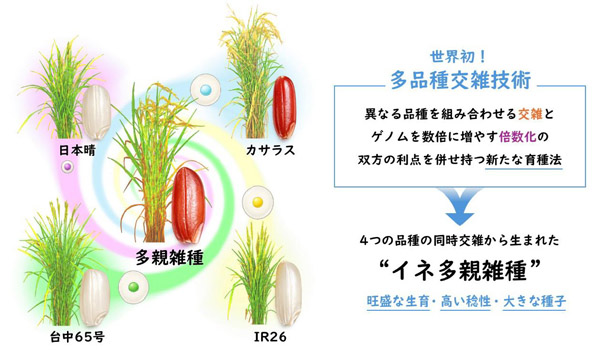
NTT and Tokyo Metropolitan University have established—for the first time in the world—a technology to simultaneously crossbreed four varieties of rice, one of the world’s three major cereal crops. This achievement enables the development of rice varieties that combine the characteristics of four distinct strains in a single step—a feat difficult to accomplish with conventional methods. In the future, this technology could lead to improvements in crop yield and functionality, contributing to increased and stabilized agricultural production as well as a reduction in environmental impact.
Under its “NTT Green Innovation toward 2040” vision—which aims to achieve both zero environmental impact and economic growth—NTT is advancing research and development into plant breeding technologies that foster low-impact agriculture. As part of this initiative, a joint research team from NTT and Tokyo Metropolitan University has been working to develop crops that not only offer superior yield and functionality but also possess high CO2 absorption capabilities and require fewer chemical fertilizers and pesticides.
By utilizing an in vitro fertilization (IVF) method—which involves fusing egg and sperm cells isolated from plants—the team successfully achieved polyploidization involving the crossbreeding of four varieties, a process previously considered difficult. Systems for regenerating whole plants from fertilized eggs created via IVF have already been established for the three major cereal crops: rice, wheat, and corn. A key advantage of the IVF method is the ability to flexibly design the number and combination of egg and sperm cells to be fused.
In this study, using rice as a model, the researchers applied the IVF method to create fertilized eggs by fusing egg and sperm cells derived from four different varieties. Furthermore, by culturing these fertilized eggs, they successfully produced rice plants that combined genomes from all four parents and possessed double the usual number of genome sets.
※Translating Japanese articles into English with AI