
Robot Delivery Service Launches at Tokyo Midtown Yaesu NTT East
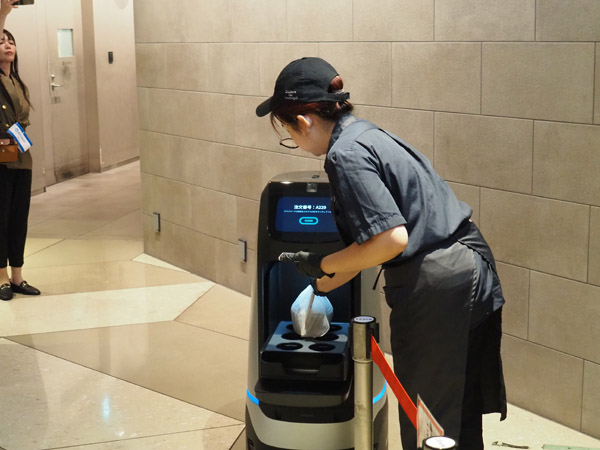
NTT East, Mitsui Fudosan, and NAVER Cloud have launched a robot delivery service at Tokyo Midtown Yaesu. The service utilizes delivery robots equipped with “Physical AI” to transport food and beverages from restaurants within the complex to offices.
In this service, delivery robots transport items from restaurants located on the B1 and 5th floors to “Work Styling Tokyo Midtown Yaesu” on the 7th floor. Office workers can place orders via LINE and receive items from the complex’s restaurants without leaving their offices—even during breaks between meetings or tasks. The process, from ordering to receipt, can take as little as a few minutes.
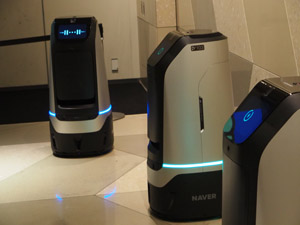
ビル内に設置された配送用ロボット(Delivery robot installed inside the building)
The delivery robots utilize a cloud-based digital twin as a shared “digital map.” By understanding the building’s layout and navigation routes within this digital space and integrating with security doors and elevators, the robots can perform deliveries across multiple floors of the large-scale complex.
This system is provided by NAVER Cloud based on a platform called ARC. Baek Jong-yoon of NAVER LABS, the company responsible for developing ARC, explains: “ARC serves not only as the ‘brain’ that coordinates the robots but also as a system that comprehensively controls various services—including building infrastructure—by leveraging the digital twin foundation.”
The digital twin of the entire building is used for functions such as simulations and for the robots and AI to determine their location. Additionally, the digital twin data can be updated using devices like smartphones.
This delivery service aims to enhance convenience for office workers through Physical AI and to boost patronage of the restaurants within the complex. Daishi Masuyama, a manager in the Business Development Headquarters at NTT East, says, “We anticipate that various challenges will arise through the use of robots. We aim to cultivate our robot services by addressing these issues while continuing to use the robots in real-world settings. Although they currently operate with a single function—delivery—we believe that implementing multiple functions will expand the range of tasks a single robot can perform.”
※Translating Japanese articles into English with AI