
Accumulating Know-How on Water-Cooled Container Data Centers MIRAIT One
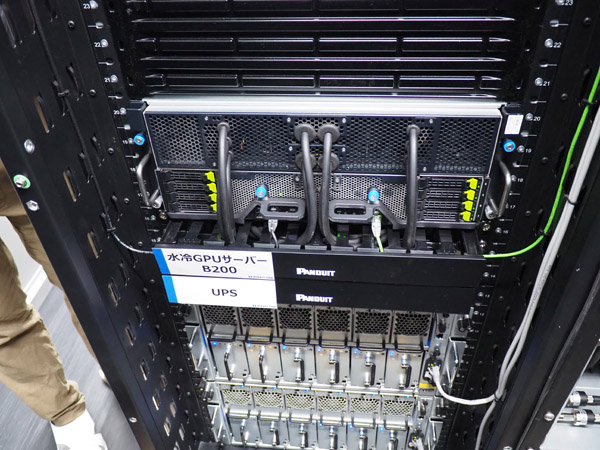
MIRAIT One has installed a water-cooled container-type data center at its Shinkiba building.
A key feature of water-cooled container data centers is their ability to be installed in limited spaces; the Shinkiba unit occupies an area equivalent to three parking spaces. Unlike conventional data centers, which require the installation of heat source units and cooling water piping, this system eliminates the need for such infrastructure, enabling a shorter delivery timeline. Construction is relatively straightforward because the container’s shell and some internal components are pre-assembled at the factory before shipment; on-site work involves only delivery, installation, and power connection.
The data center aims to build expertise in “water cooling,” a next-generation cooling technology.
Tatsuzo Miyazaki, a Senior Managing Executive Officer at the company, states: “As GPU power consumption skyrockets, current mainstream air-cooling methods face limitations in meeting energy-saving standards, making the shift to water cooling essential. Implementing water cooling presents challenges such as temperature and pressure fluctuations, as well as condensation. We are working to accumulate the know-how needed to resolve these issues.”
The company is also looking ahead to the era of “Physical AI.” As we enter this era, the demand for edge computing will rise, creating a need for distributed data centers. Container-type units are a promising solution for realizing such distributed data centers.
Miyazaki expresses the view that “in Japan, container-type data centers will serve as the point of convergence between digital infrastructure and the power grid.”
While the massive volumes of data used by hyperscalers are processed in large-scale, building-type data centers, a distributed model—known as edge computing—is becoming a crucial architecture suited to Japan’s needs. Under this model, data held by local governments and SMEs would be stored in facilities like locally installed container data centers and processed in a distributed manner at edge data centers located closer to the end-users. “In Japan, the key lies in the division of roles between large-scale, building-type data centers and small-to-medium-sized distributed data centers; specifically, optimizing regionally distributed processing is the critical factor for data processing in the country,” says Executive Managing Director Miyazaki.
Power architectures are also currently undergoing change. The spread of renewable energy has led to the regional decentralization of power generation, giving rise to a new trend of local production and consumption of electricity. At the same time, however, controlling the power supply has become increasingly complex.
Miyazaki states, “The convergence of decentralized power architectures and distributed data architectures will be the key to realizing a digital society in Japan.”
※Translating Japanese articles into English with AI