
NTT East and Saishunkan Pharmaceutical to Establish a Ginseng Cultivation Model Integrating Aquaponics and ICT
NTT East Japan, Saishunkan Pharmaceutical Co., Ltd., and Technoble have begun a demonstration experiment aimed at establishing a cultivation model for Panax ginseng (Korean ginseng) that integrates aquaponics technology and ICT.
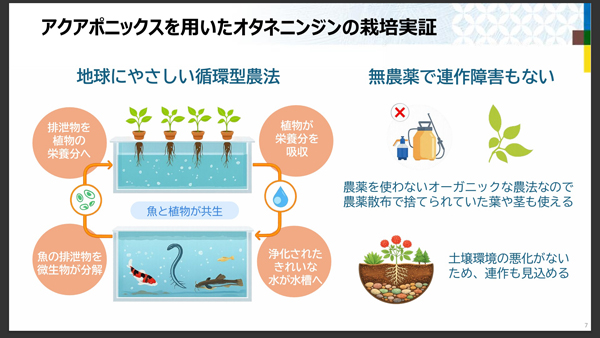
Aquaponics is a cultivation method that achieves symbiosis between fish and plants. Microorganisms decompose fish waste, and plants absorb this waste as nutrients, purifying the water. This cycle is repeated, creating a circular farming method that enhances the reproducibility of crops. Advantages include the ability to cultivate crops in a shorter period than soil cultivation without the use of pesticides.
NTT East Japan has established an “Aquaponics Lab” within its NTTe-City Labo facility to collect and analyze data on environmental factors in cultivation.

Aquaponics Labに設置された
ニシキゴイの水槽(A tank of Nishikigoi (ornamental carp) installed at Aquaponics Lab.)
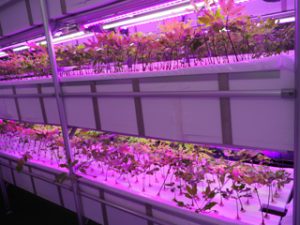
Aquaponics Labで栽培される
オタネニンジン(Ginseng cultivated at Aquaponics Lab)
Panax ginseng requires several years to mature, making continuous cropping difficult.
Fumitake Sato, General Manager of the Sales Strategy Promotion Department at NTT East Japan’s Business Development Headquarters, stated, “Through demonstration experiments, we aim to establish a highly reproducible cultivation method using a combination of Nishikigoi (koi carp) and Panax ginseng, striving to achieve both a stable supply of Panax ginseng and the creation of high added value.” To establish aquaponics, they will utilize ICT and sensors. Since the optimal growing environments for fish and plants differ, sensors will acquire data such as temperature and humidity to create the best possible environment for both. This data will then be uploaded to the cloud, where AI will perform correlation analysis to define the optimal conditions.
For Saishunkan Pharmaceutical Co., Ltd., Panax ginseng is a core ingredient and is always included in their main products.
Daisuke Maji, head of the Positive Age Division at the company, said, “Ginseng contains various components, and the key is how to bring out these effects. We are aiming to achieve a stable supply by utilizing ICT and other technologies, and we also expect additional benefits. For example, the leaves and stems of ginseng have been difficult to use until now, but if they are grown organically using aquaponics, we can expect to be able to use the leaves and stems as well.”
In fact, ginseng grown using aquaponics shows higher component efficacy than conventionally grown ginseng.
The market for ginseng is expanding and is currently approaching a 30 billion yen market. In addition to its traditional medicinal uses, its use is progressing in cosmetic and other applications.
On the other hand, cultivating ginseng is difficult, and Saishunkan Pharmaceutical Co., Ltd. relies on imports for 99% of its supply. In particular, the quality of ginseng cultivated in Jilin Province, China, is high, and they have been using it for the past 40 years. However, just like Japan, China is facing a declining and aging working population, making it uncertain whether it will be able to continue importing in the future.
It was against this backdrop that the collaboration between the two companies began.
※Translating Japanese articles into English with AI