
Responding to the Threat of Electromagnetic Pulses NTT-AT and Otowa Electric Establish High-Power Electromagnetic Field Evaluation Technology
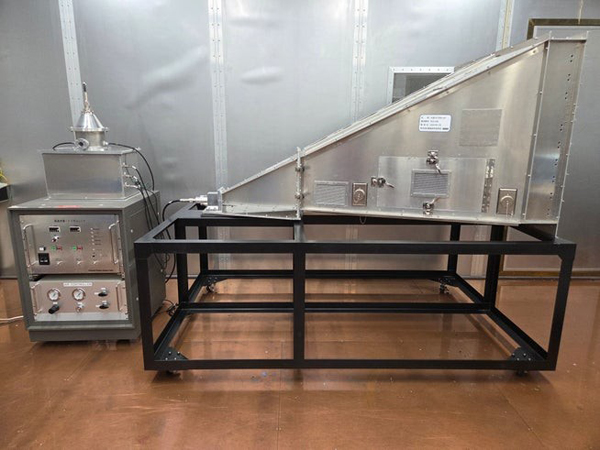
NTT Advanced Technology (NTT-AT) and Otowa Electric Industry have constructed a test facility capable of evaluating resistance to high-power electromagnetic fields (HPEM), electromagnetic pulses (EMP), and intentional electromagnetic interference (IEMI) at the circuit board and protective component level.
This facility consists of a high-voltage, compact G-TEM cell (pictured) that does not use SF6 gas, as well as a microwave test system and a broadband stripline test system. This makes high-field testing, which previously required large-scale equipment, possible at the laboratory level.
SF6 gas is sulfur hexafluoride. It is colorless, odorless, and non-flammable, and is used as an insulating material and arc extinguishing material in electrical equipment. In the power sector, it is used in circuit breakers and switches.
The G-TEM cell is constructed by expanding a portion of a coaxial cable and using a flat internal conductor; it is typically used for radiated emission measurement and radiated immunity testing.
Going forward, this achievement will be used to research and develop HPEM/EMP/IEMI protection technologies and to improve evaluation methods for enhancing the reliability of electronic equipment and social infrastructure.
While electronic equipment is rapidly progressing towards higher frequencies, miniaturization, and lower voltages, there is a growing concern that HPEM/EMP can induce strong electromagnetic energy in electronic circuits, leading to malfunctions and failures of electronic equipment due to excessive voltage and current. Furthermore, the need for protection against IEMI, which intentionally generates HPEM to interfere with electronic equipment, is also increasing internationally.
※Translating Japanese articles into English with AI