
NTT docomo Business and NTT docomo Launch 5G Slicing Service, Targeting Factories and Warehouses in 5G SA Areas
NTT docomo Business and NTT docomo will launch a new mobile network service menu for corporate clients, “5G Slicing,” utilizing 5G SA network slicing technology, as part of their comprehensive 5G consulting service for corporate clients, “docomo business private 5G.”
5G SA refers to a communication method that combines 5G-Core, a core network facility dedicated to 5G, and 5G base stations. Network slicing is a technology that virtually divides a portion of the network and flexibly occupies it according to purpose and application.
The new menu will logically divide the mobile network operated by DOCOMO and occupy a portion of the bandwidth to create a stable communication environment.
Kenji Iwamoto, General Manager of NTT docomo’s Business 5G & IoT Services Department, stated, “As physical AI and other technologies advance, a more stable network with lower latency will be required. When AI communicates autonomously, traffic can suddenly spike, and unpredictable traffic can occur due to interactions between AIs. Therefore, it is necessary to provide flexible and comfortable communication services even during sudden congestion.”
NTT docomo Business has previously provided stable communication with “5G Wide” and “Local 5G Type D,” but is now adding “5G Slicing.” Stability, ease of implementation, and flexible bandwidth allocation are unique features of 5G Slicing.
“It is hardly affected by congestion and, because it utilizes the carrier network, it is easier to implement than a private network. Location, time, and capacity can also be flexibly set,” said Iwamoto.
5G Wide is based on priority control and can provide communication over a wide area. 5G slicing doesn’t prioritize bandwidth; rather, it creates dedicated roads by slicing the network, resulting in increased stability. Local 5G, being a private network, provides dedicated bandwidth for users.
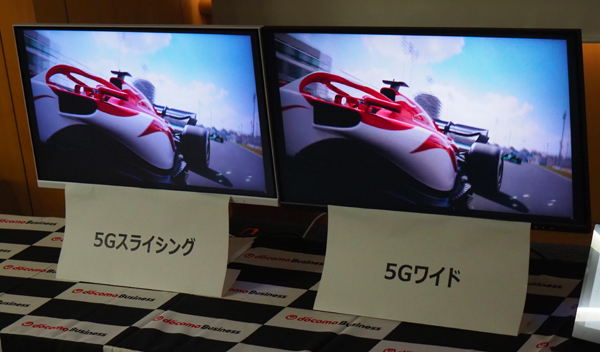
To verify the effectiveness of 5G slicing, the company conducted communication comparisons at four locations in Tokyo, including around train stations and event venues. Specifically, they compared three methods—general communication, 5G wide, and 5G slicing—by sending and receiving video in congested communication environments.
When playing 4K video near Shinjuku Station West Exit, which is a SA area, both 5G slicing and 5G wide functioned. General communication experienced delays.
Furthermore, in a crowded outdoor event environment within the SA area, 5G slicing functioned. General communication experienced video distortion due to congestion. 5G wide gradually experienced video delays.
The verification results showed that 5G slicing is the most effective communication method in congested environments.
On the other hand, SA areas are not yet widespread throughout the country. Since 5G slicing cannot be used outside of SA (Service Area) areas, there may be cases where there is a need but it cannot be met.
Regarding this point, Mr. Iwamoto said, “Our primary target is not area-wide deployments such as autonomous driving or trains. For the time being, we will focus on fixed use cases such as factories and warehouses. We also have a menu that allows us to build base stations in the SA areas requested by our customers, so we would like to proceed with methods for expanding SA areas by proposing such menus as a set.”