
Toshiba and MIRISE Technologies Equip Robots with Quantum Technology
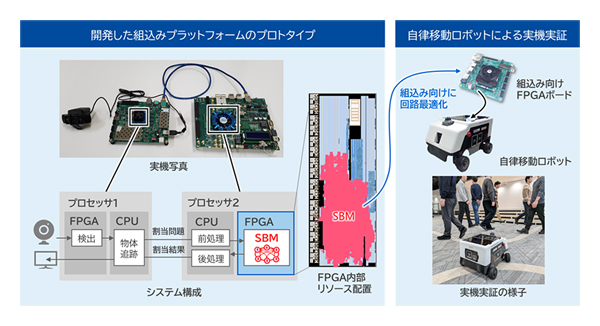
Toshiba and MIRISE Technologies jointly demonstrated the effectiveness of applying Toshiba’s proprietary quantum-inspired optimization computer, the Simulated Bifurcation Machine (SBM), to the advanced control of autonomous mobile robots by incorporating the computer into an autonomous mobile robot developed by MIRIZ Technologies.
The quantum-inspired optimization computer uses algorithms inspired by the principles of quantum computing to rapidly solve complex combinatorial optimization problems.
Autonomous mobile devices, such as self-driving cars and autonomous mobile robots, face the challenge of performing increasingly sophisticated information processing in real time while maintaining constraints such as size, power consumption, and cost. Toshiba developed a “multi-object tracking algorithm” utilizing SBM and implemented it in an embedded FPGA using a proprietary circuit design, thereby resolving these challenges.
Furthermore, MIRISE Technologies equipped the FPGA on an autonomous mobile robot and demonstrated the feasibility of real-time autonomous movement.
In the past, quantum-inspired optimization computers have been installed externally to moving vehicles and used for centralized control. However, in this demonstration, the quantum-inspired optimization computer was installed inside the moving vehicle and applied directly to the control of the autonomous vehicle. This marks the first such effort in the world.
The two companies plan to further expand the range of applications of the embedded quantum-inspired optimization computer in the field of autonomous control, such as self-driving cars and robots.
Specifically, they plan to apply it to a variety of on-site challenges, such as the cooperative control of multiple autonomous moving vehicles, route optimization in more complex environments, and real-time task allocation.
They also plan to expand applications to a variety of embedded devices, such as transport robots in factories and warehouses, autonomous work machines in the construction and agricultural fields, smart cities, infrastructure monitoring, and energy management systems.
※Translating Japanese articles into English with AI