
Quantum Key Distribution via Satellite Toshiba
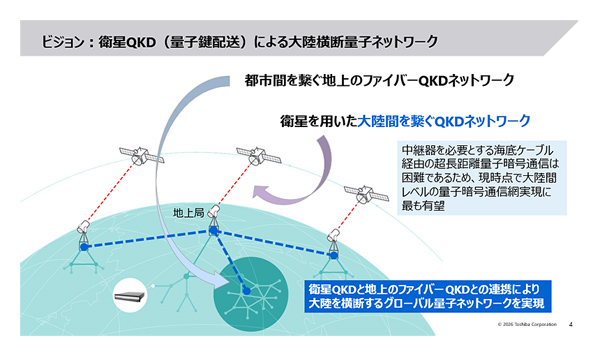
Toshiba has developed a satellite QKD transmitter/receiver system that combines high speed and compactness, aiming to commercialize long-distance quantum key distribution (QKD) via satellite in the field of quantum cryptography communications. The company has demonstrated its integration with an optical fiber QKD network at Heriot-Watt University in the UK.
The developed system achieves high-speed QKD communications using gigahertz frequencies of 1 GHz, realizes one of the world’s smallest transmitter/receiver modules, and is capable of generating a large number of encryption keys in the short time it takes for a low-earth-orbit satellite to pass overhead. The system also demonstrated a mechanism for securely exchanging encryption keys between satellite QKD and optical fiber QKD based on a standardized protocol.
Amid growing concerns that conventional encryption methods may be cracked in the future due to advances in quantum computing, QKD, which is theoretically impossible to eavesdrop on, is attracting attention as a technology supporting next-generation information security. However, due to signal attenuation, communication distances using optical fiber alone are limited. Integration with satellite-based QKD (satellite QKD) is expected to extend communication distances.
Toshiba will achieve long-distance communication between low-orbit satellites and ground stations in fiscal year 2015, enabling operation day and night. It will also demonstrate stable operation under various weather conditions. In the future, by combining multiple satellites into a network, the company aims to build an intercontinental quantum-secure network that can safely transmit confidential information on a global scale.
※Translating Japanese articles into English with AI