
Series “Visiting the Village” 43 “Modern Village” on the Noto Peninsula A 100 year project in motion at Maura, Suzu City①
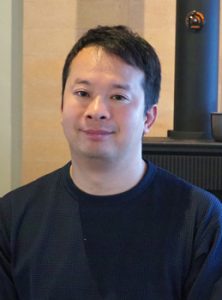
林俊伍氏(Mr. Shungo Hayashi)
A “modern village” developed in Suzu City, Ishikawa Prefecture. This is an attempt to design what a village should look like 100 years from now. The aim is to revitalize areas known as “marginal villages” into circular, sustainable areas through the implementation of cutting-edge technology. (Kei Kitajima)
An experimental project called “Modern Village” is being developed in the Maura district of Suzu City, Ishikawa Prefecture. This project started in 2020. This is an attempt to design what a village should look like 100 years from now. By combining wisdom, ingenuity, and cutting-edge technology, we aim to revitalize areas known as “marginal villages” that have suffered due to depopulation and aging into sustainable, recycling-oriented areas.
Shungo Hayashi, representative director of the Gendai Village General Incorporated Association, explains, “Our goal is to create a prosperous area where people will still want to live 100 years from now.On the other hand, we don’t quite have a clear idea of what a prosperous community will look like 100 years from now.Therefore, we started the Gendai Village with the idea of trying an experiment.”
Mr. Hayashi is also the manager of Kominguru Co., Ltd., a general trading company in the region, which handles minpaku, roadside station operations, consulting, and human resource development.
“At Kominguru, we are working to create industry in the region and enable people to develop their careers in the region. From this perspective, we position modern villages as an R&D activity.”
The modern village began with a discussion in an online salon. The number of salon members has gradually increased, and now we are having lively discussions.
“The initiative to pursue affluence 100 years from now is more of an activity and a movement than a business, so we decided that it would be better to separate it from Kominguru.In February 2025, we established it as a general incorporated association, which continues to exist today.” (Mr. Hayashi)
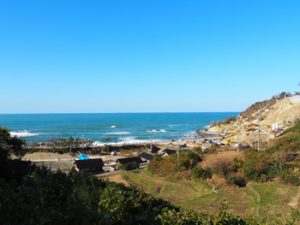
真浦地区の風景(Scenery of the Maura district)
Many of the members of the online salon are executives or people involved in town development. There are almost no people who love nature and yearn to live in the countryside, or people who turn their backs on civilization and aspire to a primitive life like LOHAS and hippies.
“We are thinking about passing the baton of a prosperous life to the next generation.We do not deny making money, but we also understand that financial capitalism is becoming unreasonable.With these points in mind, an important theme is how to pass the baton to the next generation,” Hayashi says.
By the way, how do modern villages define “affluence”? The concept of abundance is discussed every time at the salon, but there are so many different ways of thinking about abundance that it is difficult to summarize. For this reason, modern villages deliberately do not define affluence.
Mr. Hayashi added, “Personally, I see it as a state in which relationships, money, freedom, enjoyment, and health are maintained in a well-balanced manner within a natural timeline.”
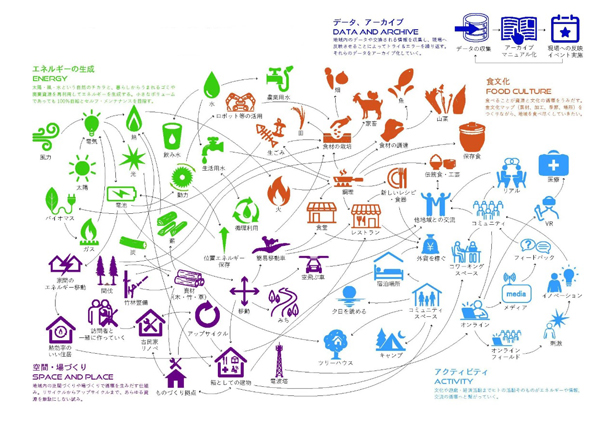
The concrete policy of the modern village is to create a “village that recycles local resources.” The idea is to make not only food but also all living infrastructure circular. This allows the company to pursue human comfort while coexisting with nature.
“Cities should move toward compact cities, but I think it would be better for dispersed areas like villages to be able to circulate water and energy within the village,” Hayashi said.
How can we become self-sufficient in water and energy? As an answer to this problem, Modern Village has devised a system called “SATOYAMA GRID” in collaboration with Associate Professor Kei Sakamura of Tokyo University of Science. By utilizing local resources such as sunlight and firewood, we will develop a system that allows access to water and energy both in normal times and in times of disaster. It is said to be a “connected off-grid” community model, and will enable the creation of sustainable communities that are resistant to disasters.
For example, when it comes to water, we consider it by dividing it into “clean water,” “recyclable water,” and “sewage water.” Recycled water is used for domestic purposes such as baths and toilets, so well water is purified before use. Use tap water when using water in the kitchen.
Energy is divided into “heating,” “hot water,” and “cooling.” Heating will be covered with firewood. The water is heated using a solar water heater that uses the sun’s thermal energy to heat water. Cooling uses electricity. Electricity will be based on renewable energy such as solar power generation.
“We are not promoting 100% energy self-sufficiency because it would be too costly. However, we would like to be able to be 60% self-sufficient in energy to make life sustainable even when we go off-grid due to an emergency.Of course, we envision that 100% energy self-sufficiency will be relatively easy to achieve with technological advances.” (Hayashi)
※Translating Japanese articles into English with AI