
NTT Sonority Launches World’s First Open-Ear Hearing Amplifier
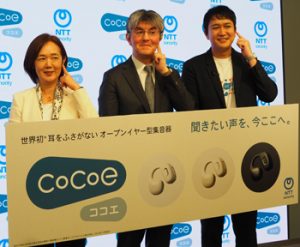
左から大西常務、坂井社長、中野氏(From left: Managing Director Onishi, President Sakai, and Mr. Nakano)
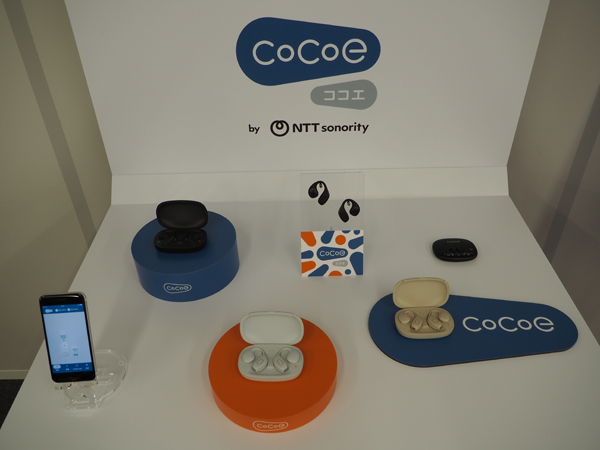
NTT Sonority is launching “cocoe,” a brand that aims to enhance everyday life with new ways of hearing.
cocoe aims to prevent social isolation due to hearing loss and realize a society where everyone can enjoy conversation and life in their own way.
As its first step, the company is releasing the world’s first open-ear hearing amplifier, “cocoe Ear,” and the project will launch on the crowdfunding site “GREEN FUNDING” on Tuesday, the 23rd. Additionally, in collaboration with NTT docomo, as part of the Docomo Hearty Style initiative, a trial of the cocoe Ear will be conducted in-store at docomo shops in Tokyo, Sapporo, and Fukuoka.
One of the issues that arise with an aging population is hearing loss. The WHO’s World Hearing Report predicts that approximately 2.5 billion people worldwide will suffer from hearing loss by 2050. According to a report published by the Japan Hearing Aid Manufacturers Association, an estimated 14.3 million people in Japan suffer from hearing loss.
Hearing loss is a significant risk factor for dementia. While hearing aids can address this issue, the adoption rate in Japan is low, at 15%, compared to nearly 50% in Europe and the United States. This means that many people continue to live with difficulty hearing.
NTT Managing Director Sachiko Onishi said, “With ‘cocoe,’ a new way of hearing that’s neither a hearing aid nor an earphone, we want to make everyone’s lives more enjoyable, richer, and more free. By working together, the NTT Group will deliver cocoe to everyone, resolving the concerns of hearing loss.”
NTT Sonority President Hiroshi Sakai said, “cocoe is a new category that combines open-ear technology with sound collection. ‘The sounds you want to hear, right here, right now.’ We embodied this idea in the brand name cocoe.”
The greatest feature of cocoe Ear is that by not blocking your ears, it allows you to hear what you hear without losing it, while providing a natural listening experience and comfort that compensates for any missing parts.
By combining NTT’s patented PSZ technology with open-ear technology know-how, it has overturned the conventional belief that systems that do not block your ears are prone to feedback.
NTT Sonority cocoe product manager Tatsuya Nakano explains, “The technical key is eliminating latency and feedback.” Latency is the time it takes for sound to enter the microphone and come out of the speaker, but if there is a time difference between the direct sound and the amplified sound, the sound quality will feel unnatural. For this reason, a high-performance chip has been adopted to reduce latency.
Sound leakage is the root cause of feedback, and sound leakage is suppressed by optimizing the layout of the microphone and speaker, as well as PSZ. It also features a software-based feedback suppression function. President Sakai said, “We believe that the market value of the open-ear hearing aid ‘cocoe Ear’ is very high. We would like to aim for sales of 100,000 units per year and sales of 3 billion yen”.
※Translating Japanese articles into English with AI