
Series “Visiting Villages” 42 What does it mean to close a community? Walking through the farm hut settlements of Showa Village, Fukushima Prefecture③
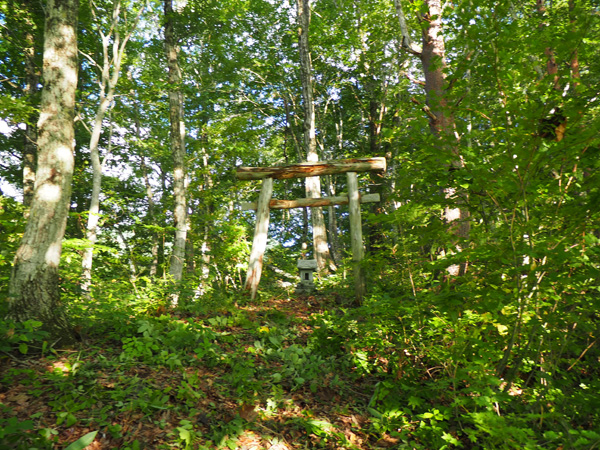
Oedazawa Tengu Shrine in Showa Village is a small, simple wooden shrine built on a small hill. Though it’s an obscure shrine, many visitors are deeply moved by its beauty. The region is home to countless beautiful landscapes that speak to the heart. (Kei Kitajima)
“The ‘Orihime System,’ a hands-on experience program for rambling weaving, launched in 1994, was Showa Village’s biggest hit,” recalls Hiroaki Kitajima.
Ramushi weaving is a unique culture of Showa Village, and for a long time, it was kept secret. However, as a lack of successors due to population decline became apparent, the disappearance of ramushi weaving became a concern. As a solution, the village decided to open up its ramushi weaving know-how, which had been kept secret within the village, and to call on women across the country to find successors. This is how the Orihime System was launched. The Orihime System is said to have significantly changed the atmosphere of Showa Village, which had previously been closed off, and made it more open and welcoming.
In fact, Yoko, Hiroaki’s wife, also came to Showa Village from Hiroshima through the Orihime System. The reason she applied for the Orihime System was not because she was attracted to ramie weaving, but because she was excited about the prospect of being able to handle the entire process from field to weaving.
“The fact that you can manage everything with your own hands was the key point for me. In fact, many women apply for the Orihime System because they want to connect with the fields,” he says.
Of course, it is impossible for one person to cover all of life’s necessities on their own, but there are many women who want to create the things that humans need to survive.
“Looking at the Orihime System, it seems to me that young women today are more aspireing to a life with their feet on the ground than in the past,” says Hiroaki.
It’s true that living in a city filled with cutting-edge systems means that even if you are accepted as a part of it, there can be a vague anxiety about whether you can really survive on your own.
“The elderly people who live in Showa Village make their own necessities. There is something very human about them,” says his wife, Yoko.
Young women who come to Showa Village under the Orihime System apparently hope to rent the fields that these elderly people have cultivated and start by planting seeds and roots.
Hiroaki says, “Many of the women who came under the Orihime System end up moving to the village. What surprised the villagers the most was why young women would stay in a place they thought had nothing. Perhaps there is something appealing about the culture and traditions of this region, and they feel a sense of spiritual richness in it. However, the challenge is economics. Under the current circumstances, it is difficult to make a living from ramie weaving, so the question is how to make it a viable industry. If ramie weaving can become an industry, we can achieve both spiritual richness and economic success.”
Most women who apply for the Orihime System settle in the village for an average of three years. They rent vacant houses and continue weaving while working other jobs.
○○○○
We arrived at Oedasawa Tengu Shrine. The shrine sits atop a small hill. Climbing the mountain, we found the modest shrine, consisting only of a small torii gate and a shrine building, standing quietly.
Behind the shrine lies Mt. Hakase. This mountain marks the border between Showa Village, Yanaizu Town, and Aizumisato Town. Just before Mt. Hakase, there’s a stream called Oedasawa, where a large cliff faces. These cliffs, called iwakura (rock altars), are the sacred object of worship for Oedasawa Tengu Shrine.
Looking further into the distance, we can see Mt. Iide, one of Japan’s 100 most famous mountains. Known as the “Tohoku Alps” and spanning Fukushima, Yamagata, and Niigata prefectures, this impressive mountain, blanketed in pure white snow, is an impressive sight.
From Oedasawa Tengu Shrine, we can also see the Ogi village where Hiroaki and his family live. Ogi village, the home of the Sugaya clan, is dotted with 15 houses. Currently, only seven houses are inhabited, and the other villagers have moved to Aizuwakamatsu and other areas, returning only on holidays to tend to the fields, etc.
Ōedazawa Tengu Shrine has moved several times. It was built in its current location by Hiroaki’s father, Seiichi (92), who apparently made the torii gate and all the other necessary equipment for the shrine. Seiichi is still alive today, and rebuilds the shrine every 15 years because the wood rots.
Why did I want to visit Ōedazawa Tengu Shrine? It was because I heard this story from Professor Shimada Naoko.
When Professor Shimada was a student at the Research Institute for Humanity and Nature, she toured Showa Village with Augustin Berque, a French thinker, geographer, and Orientalist who studied the coexistence of nature and humans based on the concept of “fudo.” During the visit, Berque’s wife was so moved by the appearance of Ōedazawa Tengu Shrine that she declared, “If I were to convert, I would believe in this shrine!”
If it’s such an incredible shrine, I definitely want to see it.
Oedasawa Tengu Shrine is a charming shrine surrounded by abundant nature. Made of wood, its small, simple appearance is rather modest. However, there was one thing that bothered me. I timidly told Hiroaki.
“I’m an amateur and don’t have any particular opinions, but I think that shrine would be even more divine without it.”
Hiroaki hesitated, “Actually, the villagers were kind enough to buy it at the hardware store and install it. Oedasawa Tengu Shrine is originally a place for paying homage to the sacred stone, so if you ask me, that shrine isn’t necessary. If it stayed like this, it would just become a place to worship the shrine…”
※Translating Japanese articles into English with AI