
Launching the “Space AIOWN Initiative” Keynote Address by President Akira Shimada at the NTT R&D Forum
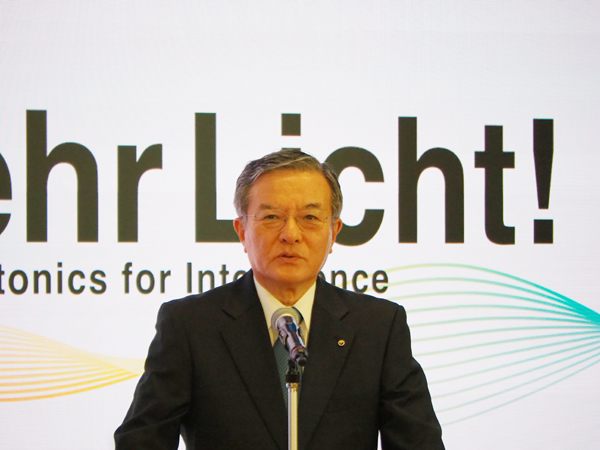
NTT R&D Forum 2026 is currently underway at the NTT Musashino R&D Center, running through Wednesday the 25th. During his keynote address, President Akira Shimada unveiled the “Space AIOWN Initiative.” A summary of his presentation follows.
NTT is taking on a new challenge: shifting from a perspective of “viewing” space to one of “engaging in dialogue” with space through light. We are pioneering this new era. By leveraging the optical technologies NTT has cultivated, we aim to weave a network of optical information throughout space—this is the core concept behind the “Space AIOWN Initiative.”
Space plays two major societal roles: “communication” and “observation.”
Regarding “communication,” satellite-based systems complement terrestrial networks. Satellites provide connectivity in areas where terrestrial infrastructure is difficult to reach—such as mountainous regions, the open ocean, or remote islands—and ensure that communication channels remain available even when ground-based facilities are rendered inoperable by disasters.
As for “observation,” Earth-observation satellites provide a broad perspective of our planet. They can capture everything from the status of disaster zones and changes in forests or oceans to the condition of infrastructure like roads and bridges.
Today, expectations for the role of space in both “communication” and “observation” are growing significantly.
In recent years, satellite communication has also been envisioned for the remote operation of vehicles. Looking ahead, the range of devices connected to satellites—including not only vehicles but also ships, construction machinery, and corporate facilities—is set to diversify. Furthermore, as the volume of data being transmitted (including video) continues to surge, there is an increasing demand for higher capacity and higher quality in satellite communication.
Meanwhile, in the realm of observation, during emergencies such as natural disasters or wildfires, it is critical to grasp exactly what is happening and where it is occurring in real time; otherwise, it would be impossible to make timely decisions regarding evacuation or recovery efforts. Consequently, there is a growing demand for both higher-resolution observation and real-time data access.
A major challenge in this regard is the communication capacity—the volume of data—between satellites and the ground. As the cameras mounted on satellites become increasingly high-definition, the amount of data they handle is surging; it is projected to reach a massive 233 petabytes per day by 2033. At this scale, transmitting data to the ground via conventional radio waves becomes difficult. Furthermore, since low-Earth-orbit (LEO) satellites circle the planet approximately every 90 minutes, they are only in direct contact with ground-based receiving stations for a limited window of time as they pass overhead.
These constraints—on communication capacity and the frequency of contact—serve as significant barriers to the full-scale utilization of space.
To overcome these obstacles, NTT is developing a method based on optical (light-based) communication. The plan involves establishing optical communication channels between satellites, as well as between satellites and the ground.
This would dramatically increase the volume of data that can be transmitted at once.
Moreover, by using laser links to relay data optically from one satellite to another, information can be delivered to the ground much faster—without having to wait for the specific satellite that captured the data to pass directly over a ground receiving station.
NTT aims to leverage its expertise in optical technology to weave an optical information network throughout space.
This is the core concept behind the “Space AIOWN” initiative.
Why is light the preferred medium? Its greatest advantage lies in the volume of information that can be transmitted simultaneously. Radio waves are limited by the available frequency spectrum; as the number of satellites increases, securing sufficient bandwidth becomes difficult, and measures must be taken to prevent radio interference between them.
Light, by contrast, offers a much wider bandwidth. While radio wave bandwidth is typically measured in gigahertz, optical bandwidth reaches hundreds of gigahertz—effectively expanding the “data highway” by tens to hundreds of times.
The benefits of optical communication extend beyond bandwidth; it also offers a distinct advantage in terms of real-time capability. Previously, it was necessary to wait until an observation satellite passed directly over a ground-based receiving station. By connecting satellites via optical links, observation data can be relayed from one satellite to the next, allowing it to be delivered rapidly to the ground through whichever satellite is currently in communication with a ground station.
However, implementing optical communication in space presents several challenges.
For instance, satellites travel at speeds of approximately 8 kilometers per second, requiring a narrow laser beam to be kept precisely aimed at a rapidly moving target. Furthermore, when transmitting data from a satellite to the ground via light, clouds and atmospheric turbulence can interfere; therefore, the choice of which satellite and ground station to connect must be made based on weather conditions. Additionally, as the satellites involved in the connection change, a system is required to dynamically switch the communication paths on the ground.
NTT, in collaboration with its partners, is working to address these challenges.
As a further endeavor, the company is also developing “space data centers” capable of processing data within space.
By performing distributed processing of captured imagery on the satellites themselves—using AI to extract only the necessary information before transmitting it to the ground—the volume of data sent can be reduced compared to transmitting entire high-resolution images. This also enables faster decision-making on the receiving end.
There is also an ambition to reach the Moon.
As lunar activities expand—such as those under NASA’s Artemis program—a stable communication link across the approximately 380,000 kilometers between Earth and the Moon will become essential. Through joint research with JAXA, efforts are underway to enable long-distance optical communication by developing technology that suppresses noise while efficiently amplifying only the communication signals.
Power supply on the lunar surface also presents a challenge. NTT is advancing the development of wireless power transmission, which delivers energy via laser beams. In experiments conducted on Earth, the company has successfully demonstrated power transmission over a distance of one kilometer.
※Translating Japanese articles into English with AI