
Fujitsu Develops Large-Scale Quantum Computers Through High-Efficiency Optical Connections
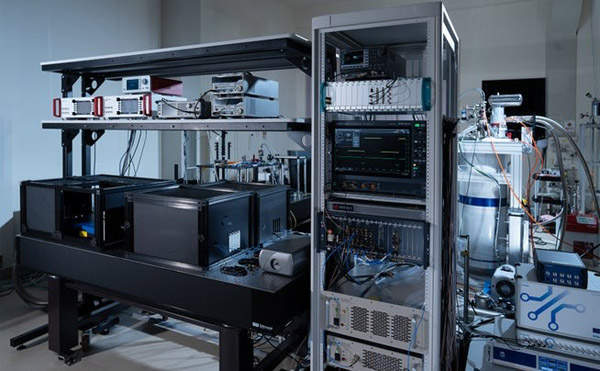
Fujitsu has developed a prototype of a diamond spin quantum computer.
The diamond spin method, with its high fidelity and highly efficient optical connection, is expected to contribute to the future scaling up of quantum computers. Fidelity is an indicator of how close a quantum state is to an ideal state; a higher value is desirable.
This is the world’s first configuration called a tin-vacancy center in a diamond crystal, approximately 10 times more than conventional systems, allowing it to operate at temperatures higher than those of superconducting quantum computers. Users can utilize this prototype via the company’s hybrid quantum computing platform, “Fujitsu Hybrid Quantum Computing Platform,” without needing to be aware of the differences between quantum computer methods.
Fujitsu is working on developing a prototype of a diamond spin quantum computer consisting of multiple quantum modules, aiming for completion by 2027. They are also working on developing connection technologies with superconducting systems, promoting research toward the realization of large-scale, fault-tolerant quantum computers by combining both methods.
Towards the practical application of quantum computers, various quantum computing methods, including superconductivity, ion traps, and neutral atoms, are being researched worldwide. The diamond spin method, due to diamond’s properties that make it easy to maintain a stable quantum state, has the potential to construct logical qubits from fewer physical qubits compared to superconductivity methods. Because quantum modules can be connected with a high degree of freedom using light, it becomes possible to construct systems with a modular architecture that has excellent scalability.
※Translating Japanese articles into English with AI