
MIRAIT One Installs Japan’s First Water-Cooled Container Data Center
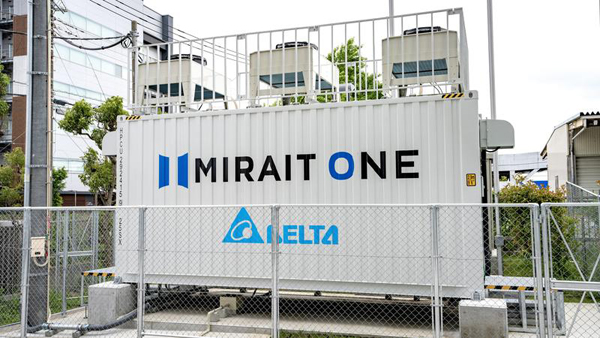
With Delta Electronics , MIRAIT One has installed the first commercial unit of a “20ft water-cooled container data center” at its Shinkiba Building. This unit is equipped with Delta Electronics’ LTA CDU (AALC) and is intended for the construction and verification of high-performance GPU servers at the MM Advanced Innovation Lab. This marks the first installation of a data center featuring Delta Electronics’ LTA CDU in Japan.
The MM Advanced Innovation Lab is a facility where MIRAIT One and Morgenrot jointly conduct specialized research, development, and verification. Their goal is to create next-generation container data centers that combine world-class safety, environmental performance, and computing power to address emerging challenges and needs in the field.
AALC is a technology that cools the circulating coolant via an air conditioning system; it was selected for the water-cooled container data center because it allows for installation within a compact footprint. Its key advantage is ease of implementation, as it eliminates the need for extensive water-piping construction and enables water-cooling capabilities by utilizing existing air conditioning infrastructure.
Anticipated use cases include establishing on-premises private cloud environments—using small, unused spaces on company premises and surplus power—to handle highly confidential data that cannot be uploaded to the cloud, while leveraging AI agents to streamline back-office operations. Another envisioned scenario involves logistics warehouse operators and solar power providers who face power curtailment (output restrictions) at rooftop installations or remote solar plants. These operators could utilize the water-cooled container data center—installed in a small, unused on-site area—to convert that curtailed power into computing power via high-efficiency GPUs, thereby reducing lost revenue and improving business viability. The water-cooled container data center is a demonstration facility designed to support next-generation infrastructure; it leverages high-performance GPU servers and IOWN technology, with operations scheduled to begin in September. Plans are in place for both domestic and international sales.
While demand for data centers is expected to grow alongside the spread of digitalization and the adoption of generative AI, the increasing performance of GPUs has rendered conventional air-cooling technologies insufficient, making a shift to water-cooling technology essential. Furthermore, although AALC (Advanced Air-Liquid Cooling) is becoming widely adopted in regions such as the United States, its implementation in Japan has lagged behind.
※Translating Japanese articles into English with AI