
Building a Wide-Area Quantum Cryptographic Communication Network Across the Tokyo-Nagoya-Osaka Region NTT docomo Business
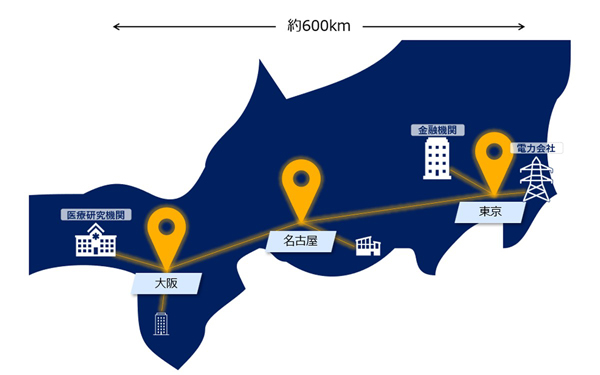
NTT docomo Business, Toshiba, and NEC have begun constructing a wide-area quantum cryptographic communication network spanning approximately 600 kilometers and connecting the three major metropolitan areas of Tokyo, Nagoya, and Osaka. This initiative is part of a broader effort led by the Ministry of Internal Affairs and Communications (MIC) and the National Institute of Information and Communications Technology (NICT) to implement Quantum Key Distribution (QKD) in society.
Following the network’s construction, demonstration experiments involving QKD will be conducted.
These trials will handle highly confidential data, such as information related to national security and personal data. The project aims to verify secure communication using quantum technology, with a view toward future societal implementation in sectors such as healthcare, finance, and electric power.
NTT docomo Business will oversee the entire demonstration and provide the network, data centers, and applications. Toshiba and NEC will be responsible for supplying QKD equipment and constructing the QKD network.
In addition to these three companies, the project involves collaboration with NTT-ME, Exeo Group, Sakura Internet, and Deloitte Tohmatsu.
The advancement of quantum computing technology has raised concerns regarding the declining strength of existing cryptographic technologies—currently in widespread use—whose security relies on computer performance. Consequently, there is a growing need for new communication technologies capable of securely protecting highly confidential information over the long term, as well as for secure operational practices and key management.
Addressing the risk of “HNDL” (Harvest Now, Decrypt Later)—whereby current communications are intercepted and stored for future decryption using quantum computers—has become a critical issue from the perspectives of national security, economic security, and industrial competitiveness.
HNDL refers to a type of cyberattack aimed at collecting and storing encrypted communication data now, with the intention of decrypting it later as technology advances. It is recognized as a new security risk based on the premise that “current communications could be decrypted in the future.”
Against this backdrop, attention is focusing on QKD as a technology for achieving secure communication, and on quantum cryptographic communication—a method of secure data transmission that utilizes cryptographic keys generated via QKD.
※Translating Japanese articles into English with AI