
Accelerating Resource Recycling with DPP: NTT docomo Business and CYKLUS
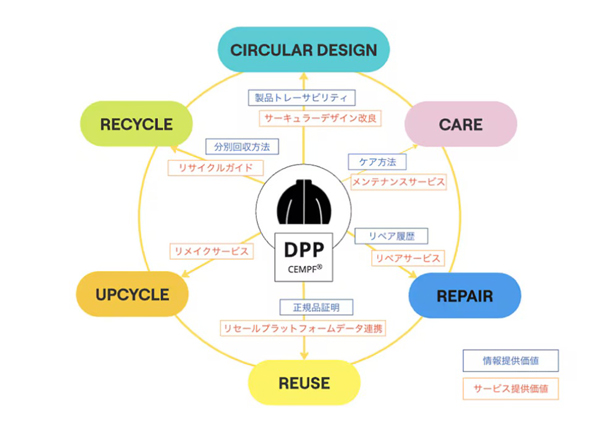
NTT docomo Business and CYKLUS will launch a joint Proof of Concept (PoC) in the apparel sector utilizing a Digital Product Passport (DPP) that provides access to product information.
A DPP is a digital certificate that enhances transparency by recording the history of a product from raw material procurement to recycling. It is gaining momentum in the EU, which places great importance on the circular economy, and is moving from the conceptual stage to the implementation phase. Specific requirements for apparel DPPs are expected to be established from 2027 onwards, with operation beginning around 2028. By 2030, it is anticipated that DPPs will be applied to many products circulating in the EU.
Ryo Maeda, head of NTT docomo Business’s Smart Industry Promotion Office, commented on these trends, saying, “Currently, environmental compliance is a prerequisite for business. Especially in the apparel industry, a major theme is shifting from a ‘sell and forget’ approach to a business model that allows for long-term use.”
In Japan, the annual supply of new clothing is estimated at approximately 820,000 tons, or about 3.5 billion garments. Of this, 70%, or 560,000 tons, are discarded by businesses and households and disposed of unused through incineration, landfill, or thermal recycling.
Not only in Japan, but the apparel industry in general is structured around mass production, mass consumption, and short-term use, resulting in a significant environmental impact.
To address these challenges, there is a need to shift to a circular business model based on the premise of long-term use, balancing environmental value and profitability.
However, until now, product information has been fragmented, making repair, reuse, and recycling difficult.
Ken’ichi Hirata, president of CYKLUS, stated, “DPP (Delivery Process Development) may play a significant role as a solution.” He added, “By centrally managing and sharing necessary information throughout the lifecycle, such as how to repair, reuse, and recycle garments, we believe we can connect this to circular services.”
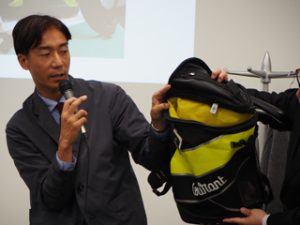
平田社長によるDPPデモの模様。製品のブランドタグの下にあるQRコードから情報にアクセスする(A demonstration of DPP by President Hirata. Information can be accessed via a QR code located below the product’s brand tag.)
The Proof of Concept (PoC) will focus on implementing a circular service that seamlessly connects the repair, collection, resale, and recycling of apparel products, as well as developing a data infrastructure that anticipates future eco-design regulations.
Utilizing NTT docomo Business’s CEMPF (Recycling Resources Circulation Platform), the project will verify user experience and operational suitability through the presentation of product information via DPP and information sharing among stakeholders.
CEMPF is a next-generation ICT platform that centrally manages data necessary for resource circulation and includes functions such as ensuring traceability and authentication. Masahide Aoto, chief specialist at NTT docomo Business’s Smart Industry Promotion Office, explains, “In the PoC, we will display the DPP using a QR code as a starting point and deploy a circular service. We will verify the potential of a business model that provides a new experience of using products for a longer period.”
Maeda, the head of the department, said, “Until now, society has been structured in such a way that the more the economy grows, the more energy and resources are consumed, and the greater the environmental burden becomes. However, the Earth cannot bear an infinite burden, so a structure is needed that allows the economy to grow while not increasing, and even reducing, the environmental burden. For this reason, initiatives such as energy conservation, renewable energy, and the circular economy are becoming extremely important”.
※Translating Japanese articles into English with AI