
Serial “Exploring Villages” 59 Summary 21: Population Decline Accelerates. The Census Reveals Japan’s State
The preliminary results of the census released by the Ministry of Internal Affairs and Communications once again highlight Japan’s declining population. Towards the 2050s, Japan’s population structure will become an inverted pyramid, marking the most challenging period. Regional decline will likely peak around this time. (Kei Kitajima)
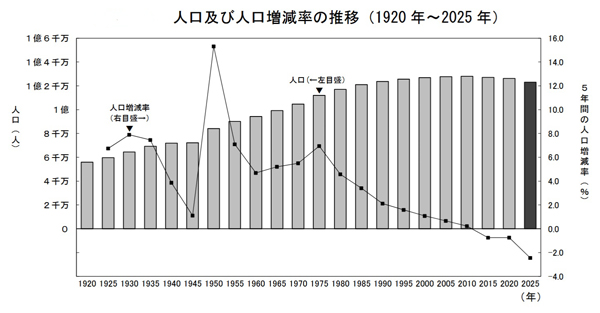
The Ministry of Internal Affairs and Communications released preliminary results of the 2025 census on May 29th (Friday). As of October 1st, 2025, the population is 123.05 million. This is a decrease of 3,097,000 people (2.5% decrease) compared to 2020. The rate of decline has widened, recording the largest decrease on record.
Population growth was limited to Tokyo and Okinawa prefectures; population declined in 45 prefectures. The population of the Tokyo metropolitan area (Tokyo, Kanagawa, Saitama, and Chiba prefectures) is 36,986,000, accounting for about 30% of the national population. The top eight prefectures by population—Tokyo, Kanagawa, Osaka, Aichi, Saitama, Chiba, Hyogo, and Fukuoka—total 63,605,000, representing over 50% of the national population.
Hokkaido, the ninth most populous prefecture, recorded the largest population decrease at 239,000, bringing its population down to 4,985,000. This was followed by Shizuoka Prefecture (a decrease of 164,000 to 3,469,000) and then Hyogo Prefecture (a decrease of 141,000 to 5,324,000). In terms of population decline rate, Akita Prefecture led the way at 8.1%, with a population of 882,000, followed by Aomori Prefecture at 7.9% (1,140,000), and Iwate Prefecture at 7.0% (1,126,000).
As we already knew, the reality of Japan’s declining population, driven by a low birthrate and aging population, has been highlighted once again.
If the population continues to decrease by 3 million every five years, it will reach approximately 100 million around 2065. However, the National Institute of Population and Social Security Research estimates it to be around 88 million, suggesting that the population decline is likely to accelerate further.
Regarding population decline, the real test begins now. The population decline Japan will experience in the next few decades will unfold at a speed unprecedented in any country’s history.
I am currently 54 years old and will turn 55 in October. The average life expectancy for Japanese men is currently about 81 years. Applying that directly, I have about 25 years left to live, and will pass away around 2050. According to the National Institute of Population and Social Security Research’s estimates, Japan’s population at that time will be 104.68 million.
To be honest, I have a calculating side, and when I consider Japan’s future, my scope inevitably extends only to around 2050. Japan after that is a matter for after my death, and I have a sense of resignation, or perhaps a dismissive or careless attitude, that there’s nothing I can do about it.
The 2050s will likely be the most challenging period for Japan. The aging rate will rise to nearly 40%, and the proportion of the working population (15-64 years old) will fall to 53%. The population structure will be an inverted pyramid, and regional decline will peak around this time. Local governments will likely quietly disappear as they run out of options. On the other hand, I believe that regions that survive this period will continue to thrive long afterward.
After 2050, my generation, the baby boomer generation, will pass away, and the population structure will shift from an inverted pyramid to a more hierarchical structure. Because the structure will be relatively well-balanced, society will likely become more stable. Regions should begin formulating survival strategies now, with a view to surviving the 2050s.
Incidentally, the National Institute of Population and Social Security Research predicts that the population will decrease to 51.04 million by 2100. Furthermore, they predict that the population will decrease even further to around 10 million by 2200. Since this is more than 100 years in the future, it’s naturally questionable and difficult to accept. Perhaps future generations will have a different sense of life and death than modern people, and in addition, their animalistic survival instincts will be at work, so at some point the population decline will be halted and it will start to increase. I predict that the turning point will occur around 2100, when the population falls below 50 million. This is long after my death, so there’s no way to confirm it…
※Translating Japanese articles into English with AI