
Addressing Supply Chain Risks: NTT, Asahi Group Japan, Trial Holdings, and Mitsubishi Foods
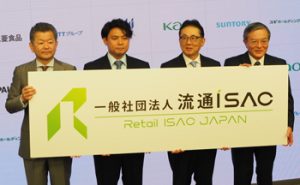
左から濱田社長、永田社長、京谷相談役、島田社長(From left to right: President Hamada, President Nagata, Advisor Kyotani, President Shimada)
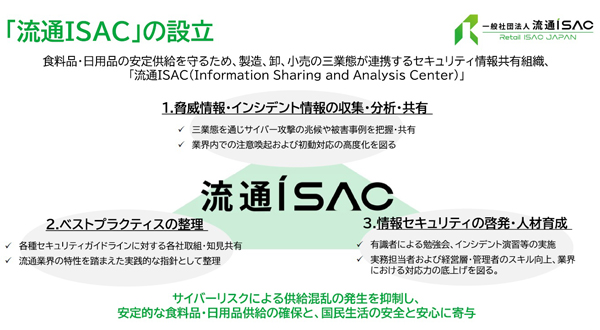
NTT, Asahi Group Japan, Trial Holdings, and Mitsubishi Foods will establish the first Information Sharing and Analysis Center (ISAC) in the distribution industry in April. This framework will facilitate cross-company information sharing and analysis, primarily in the food and beverage and daily necessities distribution sector. Together with the founding companies, they will work to improve the “collective defense capability” in cybersecurity across the entire distribution industry. NTT docomo Business will serve as the secretariat.
Amidst the raging cyberattacks, security risks in the supply chain, such as ransomware infections at trading partners and group companies, leaks of confidential information via trading partners, and data breaches, are becoming increasingly serious. There are limits to what individual companies can do to address these risks on their own. The Distribution ISAC was established against this backdrop.
NTT President Akira Shimada stated, “NTT Group has been involved with Telecom-ISAC Japan as a founding member since 2002, and continues to lead as a core member even now that it has become ICT-ISAC. Furthermore, we are the only company outside of North America to participate in Comm-ISAC, which focuses on sharing and analyzing security information, primarily in the US telecommunications infrastructure sector. We also invest heavily in developing security personnel, with approximately 5,000 mid-level personnel leading teams and 100 senior-level personnel with industry-leading track records certified under our internal certification system. We want to leverage this expertise to support the distribution industry.”
Kenji Hamada, President of Asahi Group Japan, commented, “At our company, we position DX not merely as digitalization, but as BX, that is, the transformation of the business itself, and we are utilizing DX as a driving force for our management strategy. On the other hand, as DX progresses, the importance of information security increases. We feel the need for the entire distribution industry to address these challenges. Through Distribution ISAC, we aim to strengthen information security across the industry and fulfill our responsibility to ensure stable supply by accelerating initial response in the event of an incident.”
Hiroyuki Nagata, President of Trial Holdings, said, “We are promoting retail DX, but there are limits to what we can achieve through retail DX reform by ourselves alone. As industry collaboration expands, information security risks mutually affect each other. For example, the use of purchasing data can lead to the risk of information leakage and the expansion of cyberattacks. Appropriately protecting and securely managing this information is essential to the reliability of corporate activities and is a management issue that will become increasingly important in the future. We have high expectations for ISAC’s activities.”
Hiroshi Kyotani, advisor at Mitsubishi Foods, stated, “The distribution industry for food products and daily necessities forms an extremely broad and complex supply chain as an intermediate distribution. Taking Mitsubishi Foods as an example, we have data exchanges with approximately 3,000 retailers, approximately 6,500 manufacturers, and approximately 400 logistics partners, and the cybersecurity risk points are numerous. If a security incident occurs in such a complex supply chain, it could have a devastating impact on the social infrastructure of food distribution. Strengthening cooperation throughout the entire supply chain is essential, and we expect Distribution ISAC to function as a core framework for strengthening security.”
※Translating Japanese articles into English with AI