
AWG recognized as “IEEE Milestone,” fifth NTT technology award recipient
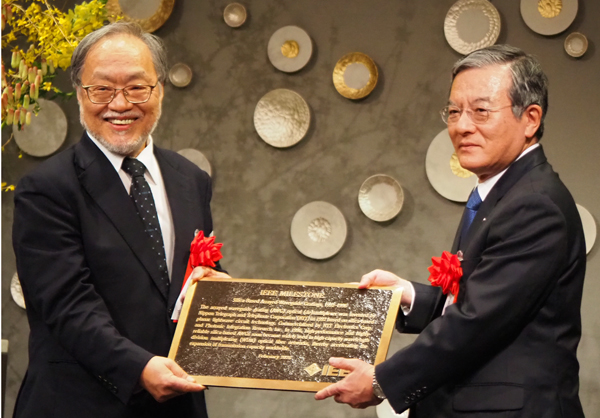
IEEE has recognized NTT’s achievements in the development and popularization of “Arrayed Waveguide Gratings (AWG) using Silica-Based PLCs,” which the company researched, developed, and promoted, with an IEEE Milestone.
IEEE Milestone recognizes technological achievements that have been internationally recognized for more than 25 years since their development in the fields of electrical, electronics, and information and communications, and have made significant contributions to the advancement of society.
This marks the fifth time that NTT’s technology has been recognized as an IEEE Milestone, following the “International Standardization of G3 Facsimile,” “Linear Pairs for High-Compression Voice Coding,” “VAD Method: Mass Production Technology for High-Quality Optical Fiber,” and “Optical Fiber Connectors with Physical Contact Connections Using a Push-Pull Fastening Method.”
AWG are a fundamental technology that has dramatically advanced the capacity of optical communications. Since the 1990s, amid the explosive growth in Internet traffic, AGW have enabled high-density wavelength division multiplexing communications, continuing to make significant contributions to the advancement of communications infrastructure around the world.
Wavelength distributors are essential for wavelength division multiplexing communications, which transmits multiple wavelengths over a single optical fiber. Around 1990, miniaturization and mass production of these devices were major challenges. In response to these challenges, AWG-type wavelength multiplexers and demultiplexers combined excellent mass productivity with high reliability, making it possible to handle dozens of wavelengths. They are also used as key devices to realize the OWN APN.
NTT President Akira Shimada said, “This IEEE Milestone is the result of 25 years of hard work by alumni, cooperating companies, and current researchers, and the plaque bears the weight of the efforts and hard work of everyone involved. I hope that the efforts of our current researchers will bear fruit, and that in 25 years we will see the birth of a succession of technologies that will be recognized as IEEE Milestones”.