
Series “CES 2026 and US ICT Trends” 5
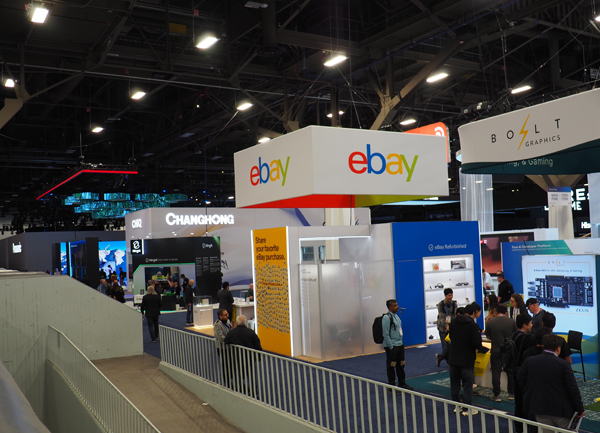
According to the official announcement of CES 2026, the number of exhibitors was over 4,100. By country, the United States overwhelmingly accounted for more than half of the total. China was next in number, followed by South Korea. Frankly, the presence of Japanese companies was very low.
This article will discuss the trends of Japanese companies at CES 2026. First, it is necessary to explain Japan’s position at CES. Frankly, Japan’s presence was very low. It might even be more accurate to say that it has no presence at all.
According to the official announcement, the number of exhibitors at CES was over 4,100. By country, the United States overwhelmingly accounted for more than half of the total. China was next in number, followed by South Korea. Roughly speaking, the US, China, and South Korea accounted for about 90% of the total, giving CES the feel of a US-China-South Korea festival. Japanese companies accounted for only a few percent of the total, fewer than Taiwanese companies.
Turning our attention to the CES Innovation Awards, 284 awards were given out, 168 of which were from South Korea, accounting for 60% of the total. Japan, by comparison, won seven awards. Japan was once hailed as a technological and electronics powerhouse and a driving force behind CES, but in recent years, its decline is undeniable. The withdrawal of Japanese companies was particularly noticeable at CES 2026. Nikon, once a staple at the central venue, has disappeared, and Sony, once the face of CES, has been replaced by AFFELA (the EV brand of Sony Honda Mobility).
Why have Japanese companies lost their presence at CES? We need to explore the reasons behind this.
One thing we can say is that the nature of CES itself is changing. CES was once known as a “consumer electronics trade show.” Back then, “home electronics was Japan’s specialty,” and Japanese electronics dominated the world. As a result, Japanese companies played a leading role as the face of CES.
Meanwhile, today’s CES is an “innovation trade fair” and has been differentiated from the consumer electronics show. While consumer electronics are still exhibited, they are a relatively minor presence.
Back when it was a consumer electronics show, it was an ideal venue for promoting one’s own products. However, as an innovation trade fair, it has become less about promoting products and more about negotiating collaborations or appealing to investors, which may no longer suit the purpose of Japanese companies. As a result, Japanese companies may be withdrawing one after another.
As is well known, the yen is currently on a weaker trend, and prices in the United States are higher than in Japan, making exhibiting at CES more expensive than ever. Given this economic environment, some companies may be choosing not to exhibit at CES.
Additionally, Japanese companies tend to place more emphasis on the Mobile World Congress (MWC) than on CES. ICT companies (telecommunications carriers and device manufacturers) in particular are keeping a close eye on MWC, which brings together the latest technologies such as AI, IoT, 5G/6G, and AI. These circumstances are also thought to be contributing to the poor performance of Japanese companies at CES.
That being said, CES is one of the world’s largest innovation trade shows, and having a strong presence there is a major boost to business expansion around the world. There’s no doubt about this. It also serves as a kind of barometer of a country’s national strength.
Just walking around the CES venue, I was honestly impressed, thinking, “The US and China are really going strong. It’s a real US-China showdown,” and “South Korea is full of energy.” I was also honestly disappointed, thinking, “What’s wrong with Japan compared to them?”
For example, a wide variety of robots were on display at this year’s CES, many of which were made by US and Chinese companies. Some of the robots made me scratch my head, wondering what they were used for, but the progress of technology and innovation was clearly evident. However, Japan, known as a robotics powerhouse, was nowhere to be seen. This leads people to conclude that “Japan is lagging behind in the field of robotics as well,” and they stop paying attention to the Japanese robotics industry itself.
In recent years, CES has become a show market, and there is no denying that it has become a performance venue where all that matters is to stand out with big fireworks. For Japanese companies that are strongly oriented toward authenticity and seek substance, this may not necessarily be a comfortable event. Nevertheless, to expand business globally, it is necessary to make one’s presence known in any way. It is extremely unfortunate that Japan is so absent from CES, and something must be done. (Kei Kitajima)
※Translating Japanese articles into English with AI