
Series “Visiting the Village” 45 Professor Kumazawa of Osaka University of Economics Explores Regional Revitalization Using Knowledge Graphs

熊澤教授(Professor Kumazawa)
A knowledge graph is a knowledge network that systematically links various pieces of knowledge and displays them in a graph structure. Professor Terukazu Kumazawa of Osaka University of Economics is conducting research with an eye toward regional revitalization using knowledge graphs. (Kei Kitajima)
Professor Terukazu Kumazawa of the School of International Collaboration at Osaka University of Economics is conducting research on regional revitalization using knowledge graphs.
A knowledge graph is a knowledge network that systematically links various pieces of knowledge and displays them in a graph structure. By visualizing and attaching meaning to the connections between data, it is possible to identify essential needs from the user’s perspective and generate new ideas.
Professor Kumazawa is aiming to use a digital archive based on a knowledge graph as a tool for regional revitalization.
“Digital archives share society’s knowledge, cultural, and historical resources, and become a social infrastructure that supports future intellectual activity. I want to get involved in local communities and build them together with their residents. By introducing ICT technologies, including digital archives, I hope to be able to put the present into perspective and effectively envision the region’s future.”
The reason for focusing on digital archives is that respecting the history and culture rooted in a region is important in promoting regional development, and archives are a valuable resource for understanding history and culture.
As is well known, Japan’s population is declining, making it increasingly difficult to manage local governments. In response, municipal mergers are underway. This trend is likely to accelerate in the future.
At the same time, looking at local areas, unique histories and cultures have been built up through life in small communities such as towns and villages.
When these towns and villages merge, the history and culture that have been built up over the years fades away. When these towns and villages merge to form a single city, new residents usually move in over time, and the fact that they were once towns or villages is often forgotten.
Professor Kumazawa says, “Regional development should ideally be based on the history and culture of small, dispersed communities, but the current trend is to view regions in larger units. I believe digital archives would be an effective counter to this trend.”
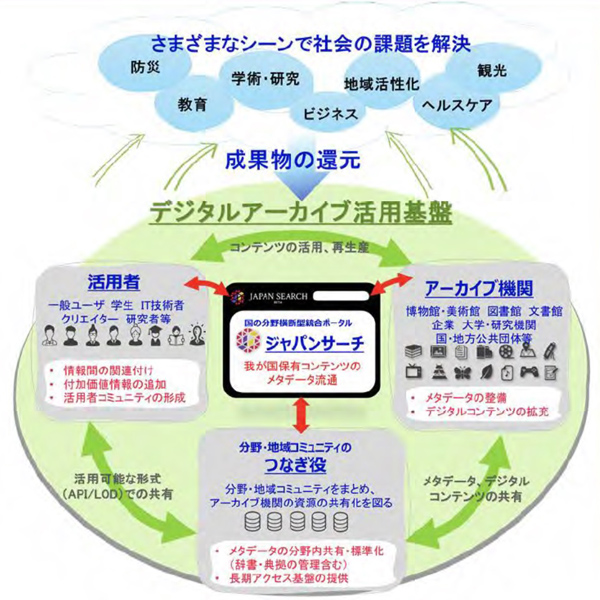
Digital archives are generally operated by museums, art galleries, libraries, archives, universities and research institutes, government agencies, and local governments. In addition, in recent years, archiving activities led by local residents have also been seen, conveying the subtle history and culture of their region.
While awareness of regional digital archives is increasing, issues have also begun to emerge. One issue is that their purpose is not clear beyond “preserving records for future generations.” There is a shortage of manpower for digitization work, and the system to support the continuation of archives is weak. Another issue is that archives are not being fully utilized in the local community.
Professor Kumazawa says, “I believe it is important to create a society that actively utilizes digital archives. However, at present, archives have no clear purpose other than to preserve records, so many people are confused about how to use them. Creating a system for effective archive utilization, such as for use in inquiry-based learning, will increase the sustainability of archives.”
For example, the Yamanashi Design Archive, run by the Yamanashi Prefectural Industrial Technology Center, collects cultural heritage from Yamanashi Prefecture, such as Jomon pottery, dyed stencils, and Kai silk patterns. However, it is more than just an archive; by applying Jomon pottery patterns and Kai silk patterns to industrial design, it aims to utilize the region’s traditional culture and resources in industry.
“The key to sustaining digital archives is not just the preservation, inheritance, and sharing of culture, but also secondary use as content and dissemination of information both domestically and internationally. Digital archives have more than one purpose; they can be developed into a variety of applications. By creating a systematic structure using a knowledge graph, we can not only preserve, inherit, and share culture, but also create business models and serve as an engine for revitalizing local areas,” says Professor Kumazawa.
※Translating Japanese articles into English with AI