
Rikuzentakata City, University of Tokyo, and NTT DX Partners Enhance Regional Disaster Prevention Capabilities
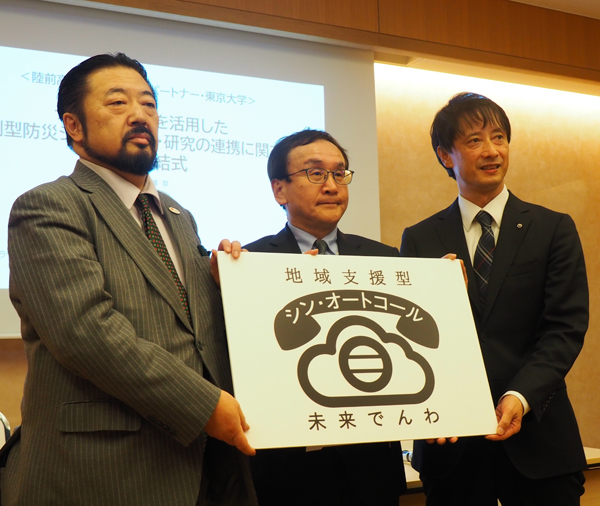
On January 14, Rikuzentakata City, Iwate Prefecture, the University of Tokyo, and NTT DX Partners signed a collaboration agreement to contribute to improving regional disaster prevention capabilities. Specifically, the agreement will promote comprehensive research on the utilization and adoption of digital technology in disaster prevention measures. Research will be conducted on the operation of Shin Autocall, the functions to be implemented, and data utilization.
Shin Autocall is a system that utilizes the cloud and generative AI to simultaneously distribute, collect, and analyze information via automated voice messages over landlines and mobile phones. It was jointly developed by Rikuzentakata City and NTT East with the aim of delivering evacuation information to residents in areas where disaster prevention radio broadcasts are difficult to hear, as well as elderly people unfamiliar with digital devices.
Shin Autocall is currently used in approximately 20 municipalities. The three parties aim to further evolve Shin Autocall and contribute to solving social issues.
Rikuzentakata Mayor Taku Sasaki said, “The region is facing the problems of declining population and depopulation, and the shrinking scale of government administration is undeniable. At the same time, disasters are becoming more severe, and it is expected that traditional preparations will not be enough to cope. The use of digital technology will be essential for future disaster prevention measures, and this agreement is very encouraging.”
NTT DX Partner Representative Yutaka Hasebe said, “Disaster prevention measures do not just involve incorporating digital technology; we must also create systems that are close to the needs of local residents. We would like to team up as three parties to create a system that is grounded in reality.” Professor Meguro Kimiro of the University of Tokyo, a specialist in disaster prevention engineering, said, “Since the Meiji era, Japan’s disaster prevention measures have been public assistance-based, led by the national government, prefectures, and municipalities. However, with the declining birthrate, aging population, and declining population, finances are becoming tighter, and public assistance-based measures will become more difficult in the future. How can we make up for the decline in public assistance? The only way is through self-help and mutual help. Self-help and mutual help are carried out by individuals and corporations. Until now, we have appealed to the conscience of individuals and corporations, but there are limits to this. Therefore, from now on, disaster prevention measures must be viewed as value, not cost, and a system must be put in place to ensure that value flows to the organizations and local communities implementing disaster prevention measures.” Disasters are very limited in both time and space. In other words, they rarely occur. With this in mind, he argued that future disaster prevention measures need to be phase-free, improving the quality of life in peacetime while still being applicable in times of emergency. Professor Meguro commented, “Creating a system that allows these areas to expand as businesses and generate a certain level of income is extremely important for Japan’s disaster prevention measures. From this perspective, this project is promising, and we would like to continue to expand it.”
Shin Autocall is most effective in areas with populations of several tens of thousands.
The number of municipalities, which numbered 3,400 during the Heisei era, has now decreased to around 1,740. Municipalities with populations of under 100,000 account for 85% of the total, with 53% having populations of under 30,000 and 30% having populations of under 10,000.
Professor Meguro said, “In a typical local government, one in 100 local residents is an administrative staff member, but 458 local governments are short of administrative staff and are unable to assign full-time staff to disaster prevention and crisis management departments. When the population is small, the number of people affected is also smaller. However, if you compare a case in which 100 people are affected at once with a case in which a small number of residents are affected but are scattered, it is more difficult to respond when the damage is scattered. Landslides and road damage, for example, are more difficult to respond to when they are spatially larger. In situations like these, the big issue is how to implement disaster prevention measures efficiently, and the key is to propose effective solutions to this”.
※Translating Japanese articles into English with AI