
Series “CES 2026 and US ICT Trends” 1
I covered ICT trends in the US, including CES 2026. As global society undergoes major upheaval, where is the ICT sector headed in the US, the world’s largest superpower? Judging from CES, physical AI holds the key. Various solutions combining AI and robotics will pave the way for the next generation. (Kei Kitajima)
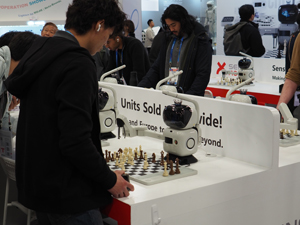
CES2026では人型ロボットの展示が目立った。ロボットとのチェス対戦やロボット同士のボクシングなど、アテンションを強調したデモが多かったが、その一方で、従来、人が行っていた作業を代替するデモも散見された (Humanoid robots were prominent on display at CES 2026. Many of the demonstrations emphasized attracting attention, such as robot-to-robot chess matches and robot-to-robot boxing, but there were also a few demonstrations of robots replacing tasks traditionally performed by humans.)
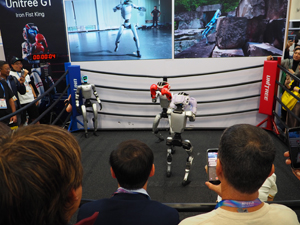
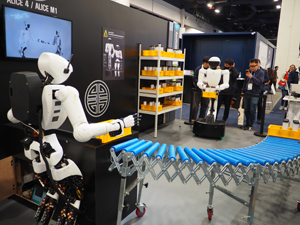
CES 2026, one of the world’s largest innovation trade shows, was held in Las Vegas, USA, for four days from Tuesday the 6th to Friday the 9th. More than 148,000 people attended from around the world, and over 4,100 companies exhibited.
This year’s CES can be summed up in one word: “overflowing with AI robots.” In other words, the atmosphere was like a festival of physical AI. The massive venue was packed with various AI solutions and robots of all shapes and sizes.
CES used to be called the Consumer Electronics Show, and had a strong image as a trade fair for home electronics, but that image is now a thing of the past. The iconic CES center hall, once dominated by Japanese electronics manufacturers, is no longer a shadow of that.
Panasonic had a large booth in the center hall, but its focus was mainly data center solutions. Sony, a CES staple, exhibited this time as Sony Honda Mobility Corporation. It unveiled a pre-production model of its AFEELA1 electric vehicle (EV).
Nikon, which had occupied the center hall until last year, was nowhere to be seen, and Samsung Electronics, which had reigned as the face of CES until last year, has also withdrawn from the center hall.
The iconic CES center hall was now a disjointed display of a wide variety of technologies, and frankly, it felt like a chaotic nebula. It was spectacular, but it was hard to discern what it meant or where it was headed. A cynical view makes it a vanity trade show.
CES remains as popular as ever, attracting worldwide attention, but walking around the center, it didn’t seem to serve as a compass to suggest the next trends.
One expert who has been watching CES for many years said, “In the past, you could tell by watching CES what the next trends would be. But in recent years, CES has lost its sense of direction. In that sense, it seems to be in a transitional period.”
As is well known, global society is currently in a state close to chaos. CES is surely influenced in no small way by this. If we look at it that way, the chaos at CES is not difficult to understand.
Furthermore, truly new trends often emerge from chaos. From this perspective, CES may currently be at a critical juncture in creating truly new trends. And the promising candidates to lead the way are likely to be AI and robots.
In addition to the Center Venue, CES is divided into the North Venue, West Venue, South Venue, and Venetian Expo, and these venues have become melting pots of innovation, which seems to symbolize CES itself.
There were many blatantly eccentric exhibits that epitomized the attention economy, and while they did not necessarily indicate clear trends toward societal implementation, it was at least clear that physical AI holds the key to the next generation.
※Translating Japanese articles into English with AI