
Series “Visiting the Village” 44 “Modern Village” on the Noto Peninsula A 100 year project in motion at Maura, Suzu City②
“Modern Villages” emphasizes the importance of being aware of what a village can and cannot do. By clearly distinguishing between domestic and foreign demand, the village seeks to define its future. He believes that advanced technologies, such as digital technology, are key to maintaining sustainability. (Kei Kitajima)
“Even if water and energy are covered by the SATOYAMA GRID, how do people make a living there?”
Hayashi says, “The key is to consider what is available within a 1-kilometer radius, what is available within a 30-kilometer radius, and what is available within a 100-kilometer radius. By looking at things this way, we can become aware of what our village can and cannot do.”
Domestic and foreign demand become clearly defined in a village. For example, farmers produce rice and vegetables, and can also fish. Living can be sustained by circulating these as domestic demand. In fact, most people in the Maura district can get by without buying anything other than meat, so they wouldn’t be inconvenienced if there weren’t any supermarkets or convenience stores nearby. That said, there still needs to be a place to buy things like toilet paper, which would be a problem if they suddenly ran out.
In this way, it’s clear what is not necessary to buy and what is necessary.
“This perspective is very important, and I believe it will be the basis for forming the community,” says Hayashi.
Meanwhile, healthcare and education are critically lacking in the current vision for modern communities, and he plans to accelerate discussions on these issues.
“Food, clothing, and shelter, as well as healthcare, education, and distribution, are absolutely essential for human survival,” says Hayashi.
While he plans to deepen the discussion, he says that with regard to healthcare, he plans to separate lifestyle-related healthcare, emergency healthcare, and prescriptions into three categories. Lifestyle-related healthcare will be handled through telemedicine and other methods. Emergency healthcare will be provided through helicopter ambulances, and drone delivery is expected for prescriptions.
He is also considering remote education and other methods for education. He says he is considering reviving marine distribution.
One of the major issues in modern villages is the population problem. Essentially, the question is how to reduce a village that previously required a population of 100 to one that requires only 10 people.
Digital and other advanced technologies are absolutely essential for this.
Hayashi explains:
“Why did people form villages? My understanding is that they lived together to produce crops like rice. For example, one person couldn’t maintain irrigation channels, which are essential for agriculture, so dozens of people had to work together to complement each other. Crops also needed to be mowed, so everyone mowed the grass. This required many people to live together. On the other hand, if robots and other technologies could take over these tasks, it would no longer be necessary for many people to live together. From this perspective, we place great importance on advanced technology.”
Robots and other physical AI are particularly expected to play an important role in agriculture. According to Hayashi, remote agriculture will become more widespread in the future, and people will be able to monitor farmland remotely. As people no longer work on farmland, robots and other tools that can take over will become increasingly important.
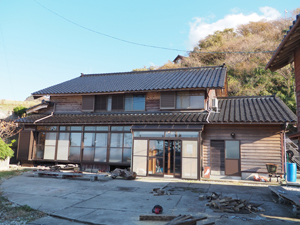
現代集落の事務所。築100 年以上の古民家(Modern village office. An old house built over 100 years ago.)
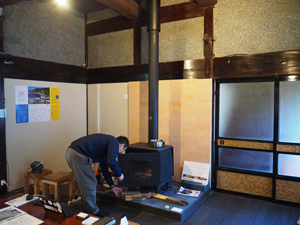
Inside the office. They use local resources, such as a wood stove for heating, to ensure water and energy are available both in normal times and in times of disaster.
The idea of reducing the number of people needed to maintain something that takes 100 to 10 is realistic in Japan, where population decline is accelerating. At the same time, efforts are also needed to increase the population of each village.
Hayashi says, “Creating industry is the most important thing. Without industry, people won’t live there. By industry, it’s probably more accurate to describe it as a livelihood rather than employment, but either way, creating industry is the key. That’s why we plan to focus on industry creation over the next few years.”
As part of this effort, the company is currently focusing on the production of tea, spices, and other products.
Incidentally, Roadside Station Noroi, located in Noroicho, Suzu City, and operated by Kominguru, produces and sells local tofu and sweets made with the rare Ohama soybeans. It’s a hit product, selling 40,000 units a year, and is said to be a business generating approximately 20 million yen.
“The tofu is made from soybeans that the local people have protected for many years, and it’s well-received. Depending on the right idea, we can create any number of industries that utilize local resources,” Hayashi says.
※Translating Japanese articles into English with AI