
NOTE152

The “Literary Flea Market Tokyo 41” was held on Sunday, November 23rd. Our company participated for the first time, selling “Toward the Age of Basics,” released through the publishing label “D-Shoroku.” It was my first experience, and I didn’t know what to do, but I gained a lot of knowledge and it was a very rewarding experience.
While the venue was overwhelmingly dominated by novels, there were also collections of tanka and haiku poems, essays, critiques, philosophy, nonfiction, and even subculture works. It was fascinating, as if I was in a melting pot of freedom of expression.
What was a bit shocking, however, was the thinness of the books for sale. Many of the books for sale were so-called miniature books, barely more than 50 pages long. To put it simply, they were like a volume of Ryunosuke Akutagawa’s short story “Mikan.” These miniature books were sold for 300, 500, or 800 yen each, and sold quite well. It’s unlikely that these types of books would be sold in a regular bookstore. “Towards an Era of Plain Books,” which was written with the intention of selling in bookstores, is around 200 pages long and felt a little out of place.
Seeing the sight of miniature books lined up in such a small space reminded me of the devastation caused by a shift away from print, but on the other hand, I was strangely convinced that this might be the modern way of making books.
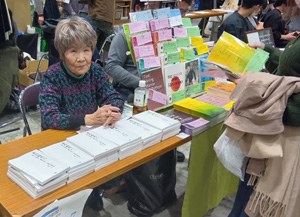
小社の出店ブース(Our company’s booth)
I myself have been taught from a young age to make proposals and documents as short and concise as possible. If you apply this style of brevity to books, you get miniature books. Young people these days seem to have the attitude of only having what they need and avoiding the unnecessary, so perhaps they are more suited to miniature books that allow you to read only what you want to read in a short amount of time.
Conversely, perhaps I am an old-fashioned person. If I’m going to read a book, I want it to have a rich vocabulary, tasteful writing with inventive expression, and I also want the content to be deep and complex. As a result, I prefer fairly thick books.
What kind of book should I create and how should I sell it? It seems we have no choice but to find our own unique methods to keep up with the times and maintain a sense of fulfillment. (Kei Kitajima)
※Translating Japanese articles into English with AI